For me, water sports are what give boating the most life and fun, especially tubing. It’s my favorite thing to do out on the lake, especially if a friend or two (or five) tag along with us. Tubing requires the little to no skill and I love throwing myself around when I’m high energy, or calmly enjoying the ride when I’d like to relax. Just about anyone can succeed with the right driver and equipment!
picking your tube
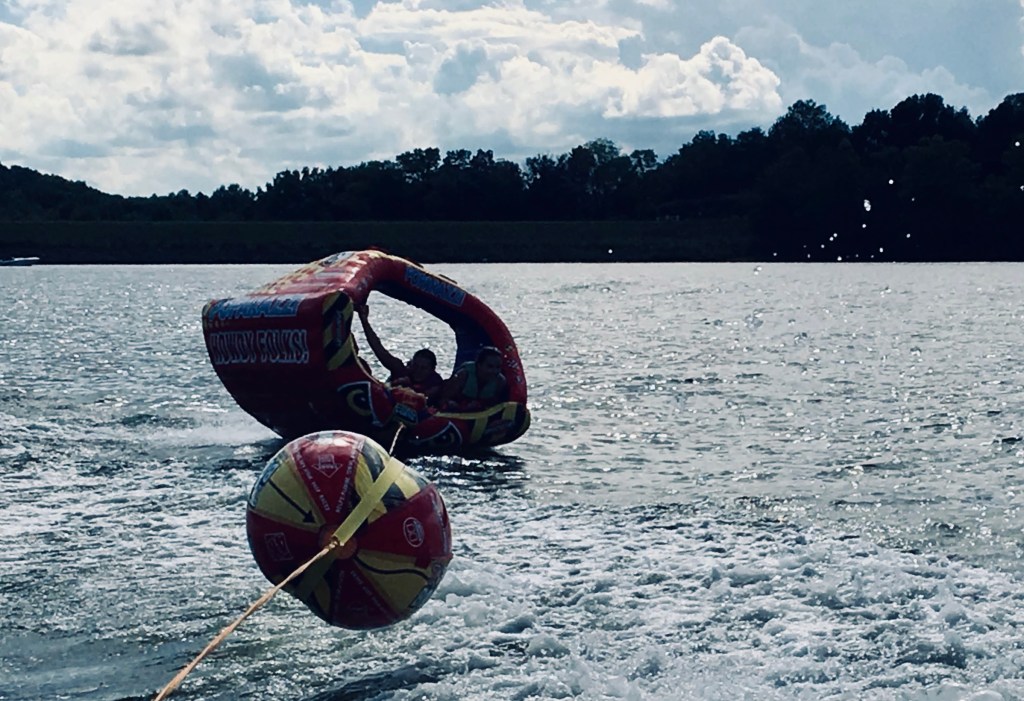
The diversity in types of tubes and things that you can do are limitless; you make your own fun by going as slow or fast as you’d like. The choice for which tube to buy may be overwhelming, but it just takes some research and assessment of what you would like to use it for. Important things to think about are:
- How old will the rider(s) be? How many?
- How experienced will your rider(s) be?
- How fast do you intend to go?
- Will the lake typically be choppy (have a lot of waves)?
Some people may just be starting out and plan to go slow with one or two younger kids. Smaller, 1-2 rider tubes with a backrest or seats may be a good choice. When pulling a nervous and/or inexperienced first-timer, it’s a good idea to go about 8-10 MPH. If you’re planning on having rowdier teenagers like my friends and I, it’s likely best to have flat 1-4 rider tubes that are more durable, or you can test out some of the funky designs (like hot dogs and swivel bullets). For experienced thrill-seekers, you can pull anywhere up to about 20, possibly 25 MPH at your discretion.
my pick
My favorite tube (our current one) is the Sportsstuff Poparazzi. It’s a 1-3 rider with a tower arched over it so you can lay down, sit, kneel, stand, or basically anything else you’d like. A warning though, if you’re interested in this tube specifically: it is quite huge and a bit of a bother to move, as it weighs about 50-60 pounds.
TUBING CHECKLIST

In addition to whichever tube you choose, you’ll need a few things:
- Boat or even a jet ski (for small tubes) capable of going 10-25 MPH
- Driver that’s aware of the lake and other boats, as well their riders
- Spotter to watch riders and inform driver when/if they fall
- U.S. Coast Guard-approved life jacket (as required by law)
- Durable rope that is suited for the weight and number of prospective riders
- It may be necessary to have a booster ball
- Air pump capable of blowing up whatever sized tube you decide on
I mentioned above that you may need an inflatable booster ball; this comes attached in the middle of a regular tube towing rope. When tubing, you may experience dragging or water splashing up in your face (especially when lying down) from the rope either being submerged or slapping the water. This was a constant with our previous tube, so my family decided to get a Sportsstuff Towable Booster Tube to make sure that the rope stays up out of the water and helps to keep to front of the tube from nosediving.
my tips
Speaking of nosediving, it is in fact possible to submerge the front, or even the entire tube, from having too much forward-leaning weight at the beginning or end of your ride. My parents and I have all had our fair share of accidentally sitting too far forward or having our feet up on the front (when we had a tube with built-in seats) and getting a foot of water over us. It drags the boat as well, so make sure your riders know to sit back at the start and finish and that your driver pays attention.
You can lean to one side of the other to move inside the wake or, if you’re feeling adventurous and can time things correctly, you can cruise outside of the wake where the water is a bit more choppy without the boat breaking it up. Here’s a pro-tip for going outside the wake or generally moving a tube more easily: when the boat is turning left, you want to lean to the right to work with the natural swing as the tube follows the boat, and vice versa with left turns.
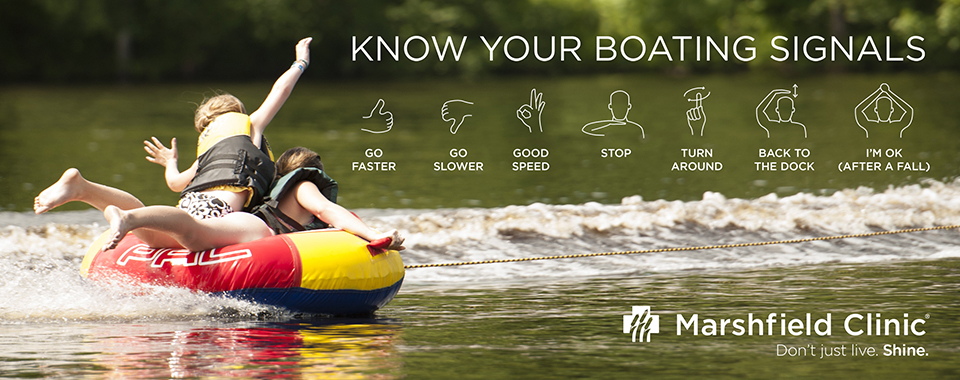
It’s a smart idea for rider and driver to exchange some easily-identifiable hand motions that are communicable when in motion. “Stop” is the most important thing to discuss, for when something is wrong or if you’re just tired out.
A good thing to tell your riders (when there’s more than one) is to not fall off intentionally after one person has already fallen. Especially on a busy lake, this can be dangerous with other boats having to avoid not one, but two or more bobbing heads that mostly blend into the water. If necessary, wave your hands in the air until your boat can swing by to pick you back up.
Other than that, I’d say you’re good to go! Make sure that you read all of the safety precautions and limits for your tube and tow rope. For the most part in tubing, you can create your own fun; comment below what you look forward to the most when tubing! As always, have fun and be safe!
Comment, like, and subscribe for more boating tips and tricks!

 Advice for the Aspiring Boater